Preparing for a job interview can be stressful, especially when you’re unsure what kind of questions might come your way. In India, interviews are often conducted in English, Hindi, or a mix of both. That’s why it’s smart to be ready for Interview Questions in Hindi, so you can express yourself clearly and confidently no matter the language used.
In this complete guide, you’ll discover the most common interview questions in Hindi, how to answer them professionally, and tips to prepare effectively. Whether you’re a fresher or an experienced professional, this blog will help you easily prepare for any job interview in Hindi or bilingual settings.
Why Prepare for Interview Questions in Hindi
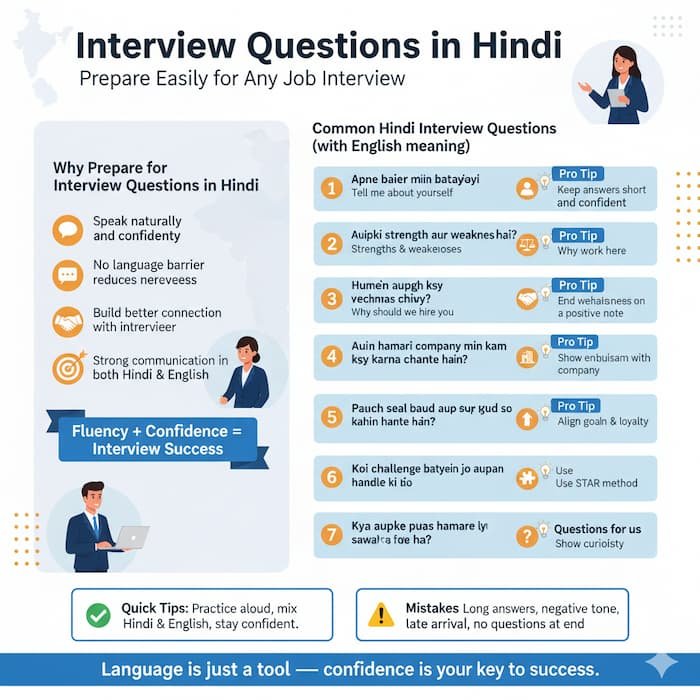
India is a linguistically diverse country, and many interviews — especially in government jobs, public sector roles, and local companies — are conducted in Hindi or Hindi-English mix (Hinglish). Preparing for interview questions in Hindi gives you several advantages:
- ✅ You express your thoughts more comfortably and naturally.
- ✅ You feel less nervous since there’s no language barrier.
- ✅ You connect better with the interviewer.
- ✅ You can show strong communication skills in both Hindi and English.
In short, preparing in Hindi improves your fluency, confidence, and clarity — making you a stronger, more versatile candidate.
10 Common Interview Questions in Hindi (with Smart Answers)
Here are the top Hindi interview questions and tips on how to answer them confidently and professionally.
1. “Apne baare mein batayiye” (Tell me about yourself)
How to answer:
- Start with your current role, education, or recent experience.
- Mention key skills and achievements.
- Connect your background to the role you’re applying for.
Example Answer:
“My name is Raj. I completed my B.Com and currently work in customer support. Over the last year, I’ve handled customer queries and helped reduce complaint resolution time by 20%. I want to bring my problem-solving and communication skills to this new role.”
Pro Tip: Keep your answer short and focused on professional details, not personal ones.
2. “Aapki strength aur weakness kya hai?” (What are your strengths and weaknesses?)
How to answer strengths:
- Pick 2–3 qualities relevant to the job (communication, teamwork, or adaptability).
- Support them with real examples.
How to answer weaknesses:
- Mention a genuine but minor weakness.
- Explain how you’re improving it.
Example Answer:
“My biggest strength is communication. I can explain complex things simply and confidently. My weakness was multitasking, but now I manage it better by planning daily tasks and using time-tracking tools.”
Pro Tip: Always end your weakness with a positive solution.
3. “Humein aapko kyu rakhna chahiye?” (Why should we hire you?)
How to answer:
- Match your skills and experience to the company’s needs.
- Show how your abilities can help them achieve goals.
Example Answer:
“You should hire me because I bring creativity, analytical thinking, and dedication. I’ve improved team performance in my past role, and I’m confident I can bring similar results here.”
Pro Tip: Focus on your impact, not just your experience.
4. “Aap hamari company mein kaam kyu karna chahte hain?” (Why do you want to work here?)
How to answer:
- Research the company’s mission, culture, or recent projects.
- Link your career goals to their values.
Example Answer:
“I admire your company’s innovative work culture and focus on employee growth. I want to work in an environment that values creativity and learning, and I feel this is the right place to grow my career.”
Pro Tip: Avoid saying you just want the job for salary — focus on long-term growth and learning.
5. “Paanch saal baad aap khud ko kahan dekhte hain?” (Where do you see yourself in five years?)
How to answer:
- Show ambition and loyalty.
- Keep your answer realistic and aligned with the company’s vision.
Example Answer:
“In five years, I see myself leading a team and handling major responsibilities. I aim to grow with the company and contribute to its long-term goals.”
Pro Tip: This question is about stability — show that you plan to stay and grow.
6. “Koi aisi challenge batayein jo aapne successfully handle ki ho” (Tell me about a challenge you faced and how you handled it)
How to answer:
- Use the STAR method (Situation, Task, Action, Result).
- Choose an example that shows leadership or teamwork.
Example Answer:
“During my internship, our project deadline was suddenly moved up. I reorganised the team, divided tasks based on strengths, and we still completed the project on time. The client appreciated our efficiency.”
Pro Tip: Always end with a positive outcome that highlights your skill.
7. “Kya aapke paas hamare liye koi sawal hai?” (Do you have any questions for us?)
How to answer:
- Always say yes — it shows curiosity and engagement.
- Ask about the role, company goals, or growth opportunities.
Example Questions:
- “What does a typical day look like for this position?”
- “How does this company measure success in this role?”
Pro Tip: Never ask about salary or holidays in the first interview unless the interviewer brings it up.
Quick Tips for Interview Preparation in Hindi
- Practice speaking your answers out loud in Hindi and English.
- Use simple, polite, and professional language.
- Maintain positive body language — sit straight, smile, and maintain eye contact.
- Avoid slang or overly casual words.
- Keep your tone respectful and confident.
Pro Tip: If you feel more comfortable, use a mix of Hindi and English. Most Indian interviewers appreciate clarity over perfection.
Common Mistakes to Avoid
- Giving long, complicated answers.
- Criticizing your previous employer.
- Sounding robotic or memorized.
- Forgetting to ask questions at the end.
- Arriving late or looking unprepared.
Remember: A calm, confident attitude always leaves the best impression.
Why Interview Questions in Hindi Matter
Being prepared in Hindi shows cultural understanding and versatility — qualities that Indian employers value. Many recruiters prefer bilingual communication since it reflects comfort, adaptability, and emotional intelligence.
Preparing for Interview Questions in Hindi not only boosts confidence but also improves your fluency, making you stand out in both local and multinational job interviews.
Long-Tail and Related Keywords for SEO
To help your content reach more readers or strengthen your online preparation, integrate these related keywords:
- Interview Questions in Hindi for freshers
- Common job interview questions in Hindi
- HR interview questions and answers in Hindi
- Hindi interview preparation guide
- Job interview questions for professionals in Hindi
- How to prepare for interviews in Hindi language
Conclusion
Preparing for Interview Questions in Hindi helps you break the language barrier, build confidence, and communicate effectively during any interview. Whether your interviewer speaks in Hindi, English, or both, being prepared ensures you stay calm, clear, and professional.
The key is to practice regularly, be authentic, and focus on clarity. With preparation, positivity, and persistence, you can easily impress your interviewer and take a big step toward your dream job.
Remember — language is just a medium; your confidence is what truly gets you hired!