Interview questions and answers can make or break your chances when you step into that selection room. Whether you are a fresher just entering the world of work or a seasoned professional seeking a new challenge, mastering these common questions and perfecting your responses is key. In India’s competitive job market, presenting well-crafted answers to key interview questions and answers showcases your confidence, clarity and fit for the role. This blog will walk you through top interview questions and answers for freshers and professionals alike, explain how to customise responses, and share practical tips to boost your interview readiness. With the right preparation of interview questions and answers, you stand a strong chance of leaving a lasting impression.
Why Prepare Best Interview Questions and Answers Early
The importance of being well prepared
When you attend an interview, you’re not just being evaluated for your resume—your responses to interview questions and answers, your communication style, and how well you align with the role matter a lot. Recruiters expect candidates to handle common interview questions and answers with ease and relevance.
Being ready with strong interview questions and answers helps you move beyond basic responses and show depth, preparation, and purpose.
Using smart keyword strategy (for your preparation too)
Using the focus keyword interview questions and answers helps you stay centred on your goal while preparing. Also include these variations:
- best interview questions and answers
- interview questions and answers for freshers
- interview questions and answers for professionals
- common interview questions and answers India
- top interview questions with answers
These variations help broaden your mindset and prepare for how recruiters might phrase things.
Readability, structure and approach
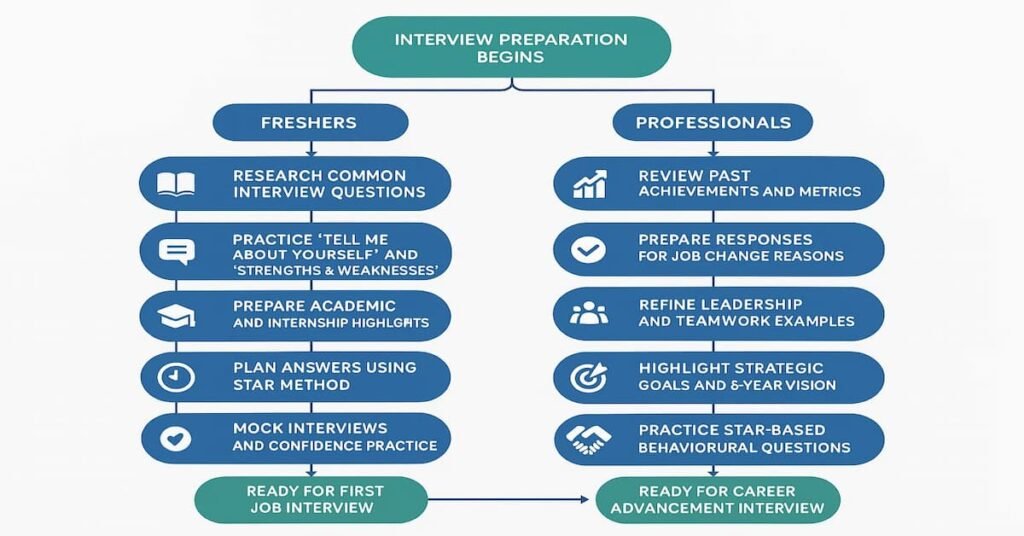
Your responses should be concise, focused and structured. For behavioural questions, use the STAR method (Situation → Task → Action → Result) to deliver compelling interview answers. Short paragraphs, bullet points and simple language all enhance your clarity. Thinking this way when preparing interview questions and answers makes your entire performance stronger.
Top Interview Questions and Answers for Freshers
“Tell me about yourself”
Why it’s asked: A common opening to understand your background, motivations and how you fit the role.
Model answer:
“I recently completed my Bachelor’s in Commerce from XYZ University. During my final year, I handled a project on digital marketing for a student club, where I increased their social media engagement by 20%. I also completed an internship at a local startup where I assisted with website content and analytics. I’m now looking for a full-time role in your organisation where I can apply my marketing interest, learn new tools and contribute to customer-driven growth.”
Key tips:
- Keep it around 1–2 minutes.
- Start with education/project, then internship/achievements, then your goal.
- Highlight relevant skills and show enthusiasm for the role.
“What are your strengths and weaknesses?”
Strength sample answer:
“One of my strengths is my strong attention to detail. For example, during my internship I identified and corrected several issues in the social media dashboard which improved reporting accuracy. I also have good teamwork skills—I led a group project in college and ensured we met all milestones ahead of schedule.”
Weakness sample answer:
“Earlier, I found public speaking challenging. To overcome it, I joined the college debate team and practiced presenting in front of peers. Over time, this improved my confidence and I now actively volunteer to lead presentations.”
Key tips:
- Choose strengths that match the job requirements.
- For weaknesses: pick something genuine, not critical for the job, and show how you’re improving.
“Why should we hire you?”
Sample answer:
“You should hire me because I bring a strong academic foundation in finance, hands-on internship experience in cost analysis and a proactive mindset. I am eager to join your organisation because of its reputation for innovation in financial products, and I believe I can help deliver insights while growing my expertise.”
Key points to cover:
- Match your skills + role requirements.
- Point out what value you bring.
- Show passion for the company or role.
“Where do you see yourself in five years?”
Effective answer:
“In five years, I see myself as a seasoned finance associate in your firm, having taken on responsibility for key projects, mentored new hires and contributed to process improvements. I aim to grow into a leadership role and deepen my expertise in financial strategy.”
Key tips:
- Be realistic.
- Align with company’s growth track.
- Focus on growth and contribution, not just personal promotion.
“How do you handle stress or pressure?”
Model answer:
“I deal with pressure by planning ahead and staying organised. For example, during my final semester I had two major assignments plus my internship. I made a timeline, set daily goals, coordinated with my teammates and communicated openly. That helped me deliver both tasks on time without compromising quality.”
Key tips:
- Use a concrete example.
- Show you managed the situation and achieved results.
Interview Questions and Answers for Professionals
“Tell me about a major achievement recently”
Model answer:
“In my current role as Senior Marketing Manager at ABC Corp, I led a campaign to boost customer acquisition by 24% within six months. I analysed market segments, crafted targeted messaging, worked with digital teams and measured impact through analytics. The result: a 30% increase in conversions and a return on investment of 4 to 1.”
Key tips:
- Use metrics.
- Show leadership and impact.
- Be concise and specific.
“Why are you looking to leave / Why did you leave your current job?”
Professional answer:
“My current role has been fulfilling and I’ve grown significantly. However, I feel I’ve reached a limit in terms of leadership opportunities. I’m seeking a dynamic organisation like yours where I can apply my strategic skills in a broader role and contribute to organisational growth.”
Key tips:
- Stay positive.
- Focus on future growth rather than past negatives.
“How do you prioritise tasks when deadlines clash?”
Model answer:
“I prioritise tasks by aligning them with business goals and making clear plans. When I had two overlapping product launches, I created a weekly plan, communicated resource needs to the team, held daily stand-ups and ensured clear accountability. Both launches were completed on time with minimal issues.”
Key tips:
- Demonstrate planning, communication and leadership.
- Use a concrete example.
“Where do you see yourself in five years?”
Senior level answer:
“In five years, I envision myself in a leadership role within your organisation—maybe as a team head or senior manager—responsible for strategic initiatives, guiding teams, and driving growth. I’m committed to deepening my domain expertise while also broadening my managerial skills.”
Key tips:
- Align with company’s roadmap.
- Show ambition plus contribution.
“Describe a conflict or failure you handled and what you learned.”
Model answer using STAR:
Situation: Two years ago a project team missed a key milestone for a client.
Task: As project lead, I had to investigate the cause and restore the client’s confidence.
Action: I organised a root-cause discussion, identified bottlenecks, reallocated resources, improved daily monitoring and communicated openly with the client.
Result: We delivered remaining milestones in three weeks, regained client trust and secured a follow-on contract worth 20% more than the initial one.
Key tips:
- Be honest about the challenge.
- Focus on what you did and the learning/outcome.
- Use STAR structure.
Practical Tips to Excel at Interview Questions and Answers
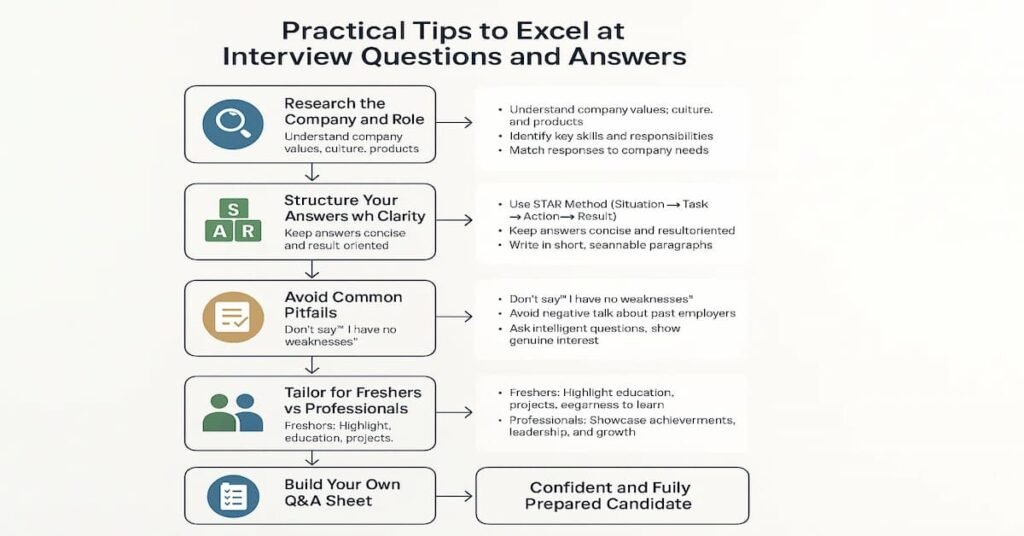
Research the company and role
- Understand the company’s values, culture, products/services.
- Identify the role’s key skills and responsibilities.
- Match your responses to what the company needs.
Structure your answers with clarity
- Use the STAR method for behavioural questions: Situation → Task → Action → Result.
- Keep your answers concise and result-oriented.
- Use short paragraphs and bullets when preparing your notes.
Practice repetition, while staying authentic
- Practice answering common questions and variations of them.
- Memorising word-for-word can make you sound robotic—use your own words.
- Use interview questions and answers practice to build confidence.
Avoid common pitfalls
- Don’t say “I have no weaknesses” or complain about past employers.
- Be ready to ask intelligent questions at the end of the interview—this shows interest.
- Ensure your responses to interview questions and answers reflect confidence, relevance and positivity.
Tailor for freshers versus professionals
- Freshers: emphasise education, projects, internships, eagerness to learn.
- Professionals: emphasise achievements, leadership, results, growth plans.
- Having a personalised set of interview questions and answers for your situation gives you a competitive edge.
Build Your Own “Best Interview Questions and Answers” Sheet
Here’s how you can build a customised sheet to prepare effectively:
- For each question you anticipate, write:
- What the interviewer is really seeking (skill, attitude, fit).
- Your tailored answer using the STAR format if applicable.
- One variation of the question (to prepare for a curve ball).
- Practice until your answer is natural, relevant and confident.
- Keep the focus keyword interview questions and answers in mind while reviewing (this helps you stay aligned with your preparation theme).
- Refresh your sheet regularly with new questions and updated responses reflecting your growth.
Conclusion
Mastering interview questions and answers is not just about memorising sample responses—it is about understanding what the interviewer is looking for, aligning your skills and experiences to that need, and delivering with clarity and confidence. Whether you are a fresher stepping into your first job or a professional looking to advance, diligent preparation of interview questions and answers will significantly boost your chances. Use the structured answers, tips and variations in this blog to craft your own responses and practise. On your next interview, make the most of your preparation, stay calm, be authentic and present yourself as the best fit. With the right approach, you’ll turn interview questions and answers into real job offers.