Films about job hunts and interviews often pack more than entertainment—they carry real-life wisdom on how to handle interview questions, present yourself confidently and navigate career moments. By studying what movies show about interviews, we can extract powerful lessons for real job-screenings. In the Indian job market, where competition is fierce and first impressions matter, watching and learning from “interview scenes in movies” can give you an edge. This blog explores several movie-inspired interview lessons, how they translate into real-life interview scenarios, and actionable tips to apply those insights in your next job talk.
Lessons from Interviews in Movies and Their Real-Life Takeaways
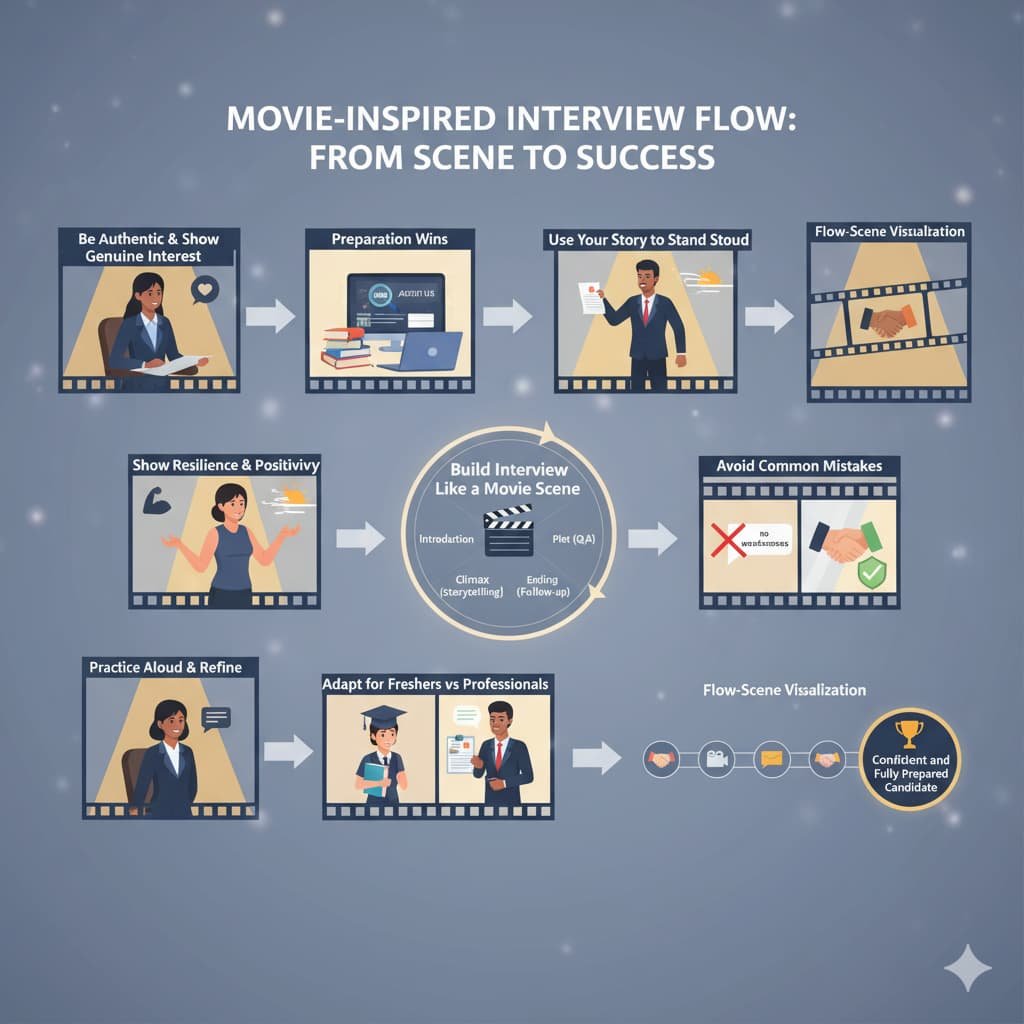
Be authentic and show genuine interest
In certain memorable movie interview scenes, the applicant isn’t perfect, but is honest, prepared and passionate. That authenticity resonates. In real life, recruiters in India value candidates who show real curiosity about the role and the company over someone who just recites polished lines. When you show genuine interest, your responses to interview questions feel more natural and credible.
Actionable tip: Prepare by reflecting on why you want the job, what excites you about the organisation, and weave that into your answer to “Why should we hire you?” or “Tell me about yourself?”.
Preparation wins: research the company and role
A strong interview scene often shows the candidate having done homework—knowing the company’s values, mission and some facts about the role. In real-life interviews, this matters more than you think. Even in India, where many freshers apply, those who show awareness of the organisation stand out.
Actionable tip: Before the interview: look up the company’s recent news, its culture, and list 2-3 ways your skills align with their needs. Mention these during “What attracted you to this role?” type questions.
Show resilience and a positive attitude
Movies often depict interviewees who have struggled, failed or been rejected but still walk into the interview with confidence. This attitude translates into real environments: hiring managers want someone who doesn’t crumble under pressure or past failures. For Indian candidates especially, being resilient and upbeat adds to your “fit” for the role.
Actionable tip: When asked “Tell me about a time you failed” or “Handled pressure”, use the STAR method: Situation, Task, Action, Result. Keep your tone positive, focus on what you learnt and how you improved – not just the failure.
Use your story to stand out
In many film interview scenes, the candidate uses a unique angle or memorable moment to make an impression. Real-life interviews work similarly: you want to be remembered for something more than generic answers. For Indian freshers or professionals both, weaving a short story or example around your answer makes you more memorable.
Actionable tip: Prepare short “mini-stories” of 2-3 sentences each for typical questions: your first project, a leadership moment, a challenge you overcame. Bring those into your answers when asked “What are your strengths?”, “Where do you see yourself in five years?”, or “Give an example of teamwork”.
Avoid common mistakes shown in movies
Films also show what not to do: being arrogant, unprepared, too casual, or giving ambiguous answers. These mistakes happen in real Indian interviews too. For example: walking in without proper attire, being vague about your achievements, or not asking questions when given the chance.
Actionable tip: Dress appropriately, arrive on time, keep your CV up-to-date, practise your answers, and always have 1-2 intelligent questions ready to ask the interviewer. Don’t say “I have no weaknesses” or “I was just bored of my last job” – these come off badly.
How to Use Movie-Inspired Lessons in Your Interview Strategy
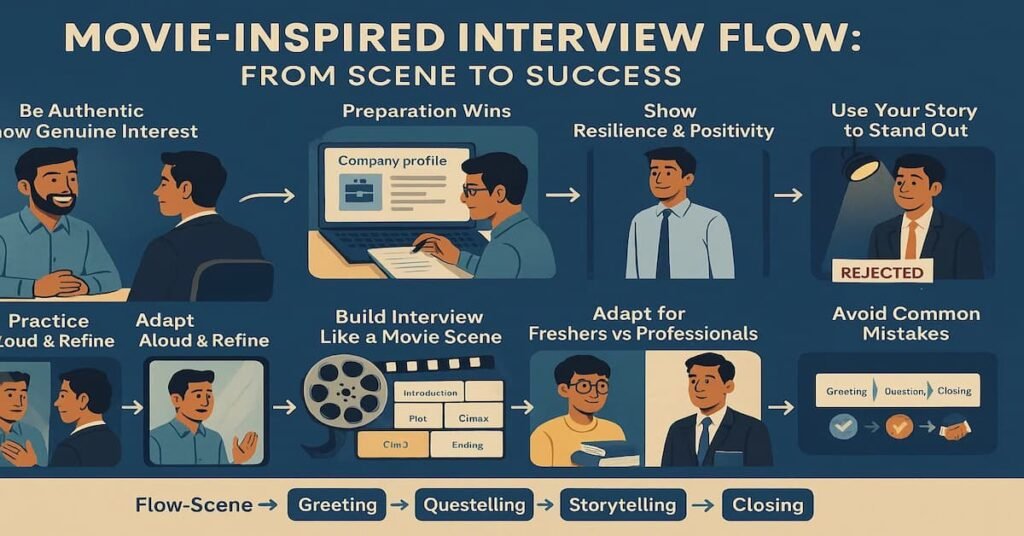
Build your interview prep like a movie scene
- Imagine you’re the star of the interview: what’s your “opening line” when they say “Tell me about yourself”?
- What’s your “plot point” (example story) for a strength, weakness, conflict or achievement?
- What’s your “climax” (biggest win or aspirational future) when they ask where you see yourself in five years?
- Visualise your “ending” – walking out feeling confident that you left a positive impression.
Practice aloud, record and refine
Just like actors rehearse a scene, you should speak aloud your interview answers. Record yourself or use a mirror. Notice your tone, body-language, eye contact (important in India too). Refine phrasing, clarity, pace.
Key focus: Short paragraphs, clear structure, bullet-style recall points (for your notes), simple language.
Adapt for freshers vs professionals
- Freshers: Focus on academic achievements, internships, eagerness to learn, adaptability. Use stories of being a student, project, club.
- Professionals: Highlight measurable results, leadership, strategic thinking, how you shifted/moved projects forward. Use stories of business impact, growth.
Movies depict both kinds of characters – the rookie who has passion, and the seasoned candidate who has depth. You can pick which style matches you and deliver accordingly.
Turn your preparation into a “flow-scene”
Craft a small “flow” in your mind (or on paper) of the interview sequence:
- Greeting & “Tell me about yourself” (opening scene)
- “Strengths/Weaknesses”, “Why should we hire you?” (middle conflict act)
- “Where do you see yourself?”, “Example of challenge/failure” (rising action)
- “Do you have any questions?” & closing handshake (resolution).
When you visualise this like a movie, you stay calm, you flow, you’re less likely to freeze or panic.
Conclusion
Movies do more than entertain—they mirror real-life job interview dynamics. By observing how characters prepare, present, handle pressure and wrap up their interview scenes, you gain actionable lessons for your own journey. Whether you are a fresher stepping into the world of work or a professional aiming for the next leap, applying these movie-inspired interview lessons will boost your confidence and performance. View your next interview as a scene you’re ready to act out—with authenticity, clarity and impact—and you’ll walk into that room prepared to shine.