Job interviews today are more about understanding your behavior than memorizing facts. Interviewers want to know how you’ve acted in real situations, what decisions you made, and what results you achieved. These are called behavioral interview questions — and they reveal the real “you” behind the resume.
In this detailed guide, you’ll learn what behavioral interview questions are, why they matter in the Indian job market, and the best sample answers using the proven STAR method (Situation, Task, Action, Result). Whether you’re a fresher or a working professional, mastering these questions will help you stand out in any interview.
What Are Behavioral Interview Questions and Why They Matter
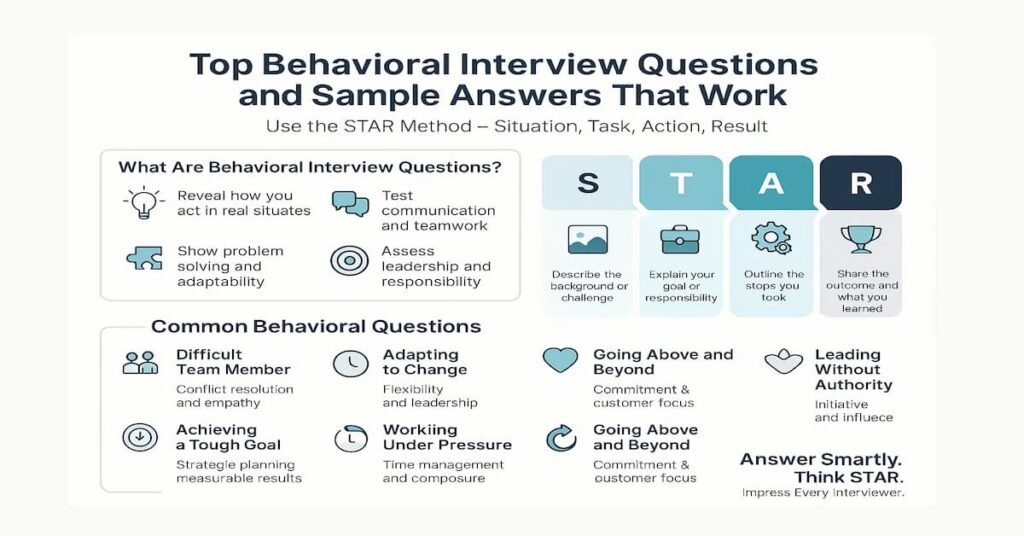
Behavioral interview questions focus on how you’ve handled real work situations in the past. Instead of asking what you would do, they ask what you have done. The logic is simple — your past behavior predicts your future performance.
These questions help employers understand:
- How you solve problems
- How you communicate and work with others
- How you manage stress and change
- How you show leadership and responsibility
In India’s competitive job market, where teamwork, adaptability, and cultural fit are highly valued, these questions help recruiters see if you’ll blend into the company’s culture and deliver results.
The STAR Method: Your Perfect Answer Framework
Before we look at sample answers, it’s important to know the structure that makes your responses powerful and easy to follow. The STAR method helps you organize your answers with clarity and impact:
- S – Situation: Describe the background or challenge.
- T – Task: Explain what your goal or responsibility was.
- A – Action: Describe what steps you took to solve it.
- R – Result: Share the positive outcome and what you learned.
Using STAR ensures your answers are not only structured but also memorable and professional.
Top Behavioral Interview Questions and Sample Answers That Work
Here are the most common behavioral interview questions with practical sample answers tailored for Indian interviews.
1. Tell Me About a Time You Worked with a Difficult Team Member
What It Tests: Teamwork, communication, and conflict resolution.
Sample Answer:
- Situation: In my previous job, one team member often missed deadlines, which affected our project schedule.
- Task: As the project coordinator, I needed to keep the project on track while maintaining a positive team environment.
- Action: I had a polite one-on-one conversation to understand the challenges they were facing. We agreed on a clear plan, set weekly check-ins, and rebalanced responsibilities.
- Result: Their performance improved, our project was completed ahead of schedule, and the team appreciated the open communication approach.
Why It Works: It shows empathy, leadership, and the ability to solve internal conflicts calmly.
2. Describe a Time You Faced a Major Challenge and How You Handled It
What It Tests: Problem-solving and decision-making under pressure.
Sample Answer:
- Situation: During a product launch, a key supplier failed to deliver components two days before the deadline.
- Task: I had to find an alternate solution quickly to prevent delays.
- Action: I contacted backup suppliers, renegotiated delivery timelines, coordinated internal teams to cover gaps, and communicated transparently with management.
- Result: The launch was delayed by only one day instead of a week. The quick decision saved major revenue losses and strengthened client trust.
Why It Works: Shows calmness under stress, strong communication, and quick problem-solving.
3. Give an Example of How You Set and Achieved a Difficult Goal
What It Tests: Goal setting, perseverance, and accountability.
Sample Answer:
- Situation: I was assigned to increase regional sales by 30% within six months — an ambitious target.
- Task: I needed to improve performance without increasing the marketing budget.
- Action: I introduced a referral campaign, re-engaged inactive clients, and provided short training sessions to help my team improve conversion rates.
- Result: We achieved a 35% increase in just five months, and I was recognised for the best regional sales growth.
Why It Works: Demonstrates strategic planning, measurable results, and leadership.
4. Tell Me About a Time You Made a Mistake and What You Learned
What It Tests: Self-awareness, honesty, and ability to learn.
Sample Answer:
- Situation: Early in my career, I made an error while compiling a report that led to incorrect client data.
- Task: I had to correct the mistake quickly and regain the client’s trust.
- Action: I immediately took responsibility, informed my manager, fixed the data, and implemented a double-check process before final submissions.
- Result: The client appreciated the transparency, and the process I introduced reduced report errors by 90%.
Why It Works: Shows maturity, accountability, and commitment to improvement.
5. How Do You Handle Working Under Pressure?
What It Tests: Time management and stress control.
Sample Answer:
- Situation: During the financial year-end, my team had to complete multiple reports and audits simultaneously.
- Task: I needed to balance my individual responsibilities while ensuring the team met deadlines.
- Action: I prioritized tasks based on urgency, created a quick daily checklist, and scheduled short breaks to keep morale high.
- Result: We submitted all reports before the deadline, and the department achieved a record accuracy rate that quarter.
Why It Works: Proves you can stay organized, focused, and positive under tight deadlines.
6. Share a Situation Where You Had to Adapt to Change Quickly
What It Tests: Adaptability and resilience.
Sample Answer:
- Situation: My company shifted from office-based work to remote operations overnight due to new policies.
- Task: As the training coordinator, I had to move all classroom sessions online within two days.
- Action: I quickly identified suitable online tools, redesigned content for virtual learning, and trained instructors on new platforms.
- Result: We successfully transitioned to online training within 48 hours, and attendance increased by 25%.
Why It Works: Highlights flexibility, initiative, and leadership in a fast-changing environment.
7. Describe a Time You Went Above and Beyond for a Client or Project
What It Tests: Commitment, initiative, and customer focus.
Sample Answer:
- Situation: A client needed urgent revisions to a marketing campaign over the weekend.
- Task: I had to meet their expectations without affecting team balance.
- Action: I volunteered to handle the revisions personally, coordinated with the design team remotely, and ensured quality delivery by Sunday evening.
- Result: The client extended their contract by six months and personally appreciated the extra effort.
Why It Works: Demonstrates dedication, responsibility, and client-first attitude.
8. Tell Me About a Time You Had to Lead Without Authority
What It Tests: Leadership and influence.
Sample Answer:
- Situation: While working as an analyst, I noticed inefficiencies in our reporting system.
- Task: I had no official leadership role but wanted to fix the issue.
- Action: I gathered feedback from peers, designed a simplified template, and presented it to my manager with supporting data.
- Result: The new template was adopted across departments, saving an average of two hours per report.
Why It Works: Shows initiative, collaboration, and informal leadership skills.
How to Prepare Your Own Behavioral Answers
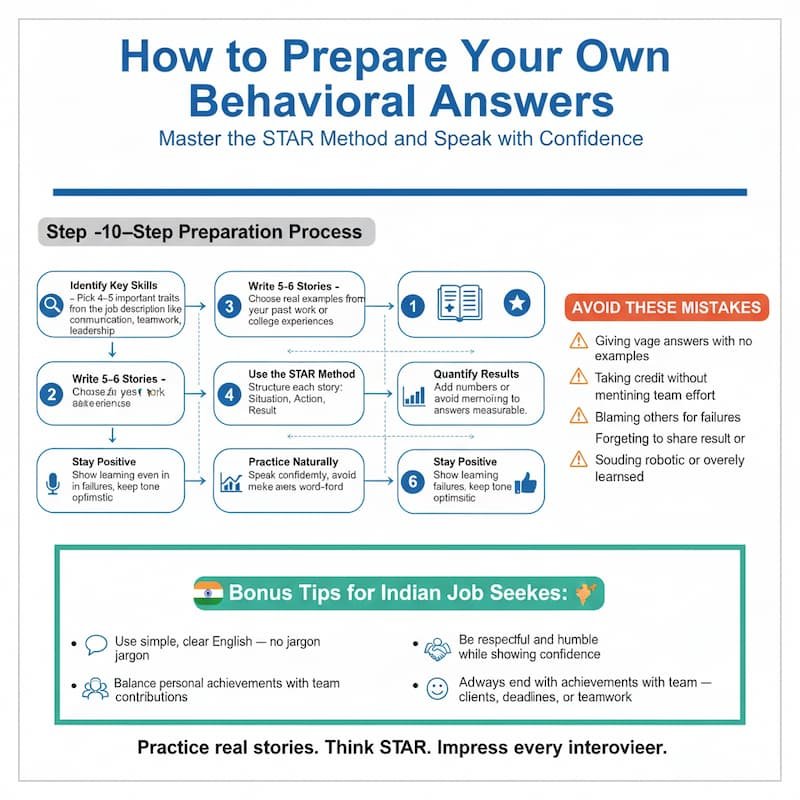
Creating your own stories is the best way to sound natural and authentic. Here’s how to prepare effectively:
- List key skills from the job description (communication, teamwork, problem-solving, leadership).
- Write 5–6 stories from your past experience that show these skills.
- Structure each story using the STAR method (Situation, Task, Action, Result).
- Quantify results — use numbers or percentages when possible.
- Practice speaking naturally; avoid memorizing word for word.
- Keep each answer between 60–120 seconds when spoken.
- Be positive even when describing challenges or failures.
Common Mistakes to Avoid
- Giving vague answers without examples.
- Taking credit for team work without mentioning collaboration.
- Blaming others for failures.
- Forgetting to mention the result or what you learned.
- Speaking too long or sounding rehearsed.
- Ignoring the importance of body language and tone.
Avoid these pitfalls to ensure your answers sound confident and genuine.
Bonus Tips for Indian Job Seekers
Behavioral questions are common across all industries in India — IT, banking, BPO, education, healthcare, and more. Here are quick tips to adapt your answers for Indian interviews:
- Use simple, professional English that’s easy to follow.
- Show respect and humility, especially when discussing leadership.
- Highlight team achievements along with personal contributions.
- Always express gratitude at the end of the interview.
- Prepare a few India-specific examples like handling clients, managing deadlines, or working across diverse teams.
Conclusion
Mastering top behavioral interview questions and sample answers that work is one of the most effective ways to succeed in your next job interview. By preparing real examples using the STAR method, staying confident, and showing your authentic personality, you’ll stand out as a thoughtful, capable, and results-driven candidate.
Remember, your stories are your proof — make them clear, relevant, and memorable. When you do, you’ll impress interviewers and move one step closer to your dream job.